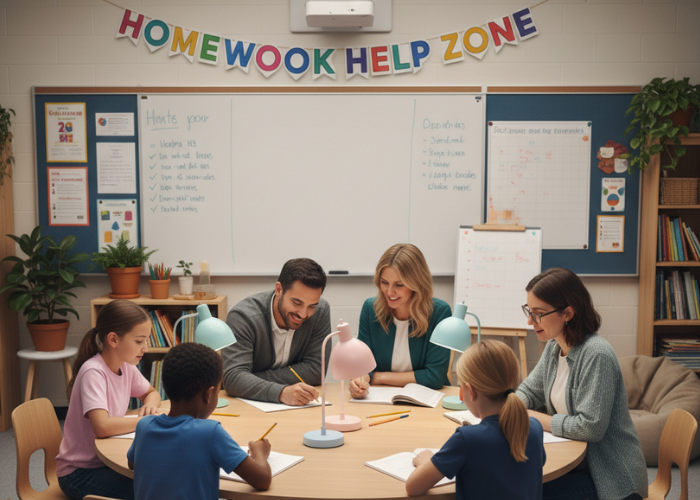
Effective homework support requires teachers to create meaningful assignments, implement differentiation strategies, establish efficient feedback systems, and build communication channels that help students succeed independently. By focusing on purpose over quantity, teaching self-assessment skills, and using technology strategically, educators can dramatically improve homework completion and learning outcomes. These evidence-based approaches benefit students at all levels while reducing teacher workload through smart systems and strategic choices about what receives intensive attention versus quick checks.
How teachers can offer better homework support starts with recognizing that homework is more than just an afterthought—it’s a critical bridge between classroom learning and independent mastery. Yet many educators struggle to provide the kind of support that genuinely helps students succeed outside school hours.
The challenge is real. Students arrive home without their teacher’s immediate guidance. They face distractions, varying levels of parental support, and sometimes assignments that feel disconnected from their actual learning needs. Meanwhile, teachers juggle grading mountains of work while wondering if their homework is truly making a difference.
Research consistently shows that effective homework support doesn’t mean simply assigning more work or spending hours grading every problem. It means creating strategic, purposeful assignments and building systems that help students develop independence while knowing help is available when needed.
For educators in online homework help, understanding modern homework support strategies isn’t just beneficial—it’s essential. Whether you’re teaching future teachers or working with students directly, these evidence-based approaches can transform how homework functions in your educational practice.
Understanding What Makes Homework Support Effective
Let’s cut through the noise. Homework support isn’t about doing work for students or drowning them in assignments. It’s about creating conditions where students can practice, learn, and grow independently while knowing they have backup.
Think about it this way: when you assign homework, you’re essentially sending students into battle without you there. The question becomes—have you armed them properly?
Effective support means students understand what’s expected, why it matters, and how to get help if they’re stuck. It means assignments match their skill levels closely enough that they can succeed without you standing over their shoulder. Research from education specialists shows that homework should reinforce what’s already taught, not introduce brand-new concepts that leave students floundering at their kitchen tables.
What Does Quality Homework Support Look Like?
Quality support has several distinct characteristics. First, assignments have clear purposes. Students know exactly why they’re doing the work and how it connects to their learning goals. There’s zero ambiguity about expectations or deadlines.
Second, the difficulty level hits that sweet spot—challenging enough to require effort but not so hard that students give up before starting. Educational researcher John Hattie’s work demonstrates that homework effectiveness depends heavily on this balance.
Third, feedback mechanisms exist. Students don’t work in a vacuum. They receive timely, specific information about their performance that helps them improve. This doesn’t mean you need to grade every single problem, but it does mean students get meaningful responses to their efforts.
How does homework support differ from just assigning work? Simple. Support means thinking about the entire homework ecosystem—before, during, and after completion. It means considering what happens when a student doesn’t understand. It means having backup plans and multiple pathways to help.
Need help with your assignment or schoolwork that is AI Free and written from scratch? Explore our comprehensive guides and connect with experienced tutors who can provide personalized support for your academic success.
Creating Clear and Meaningful Homework Assignments
Here’s an uncomfortable truth: much of the homework assigned in schools is busywork. Students know it. Parents know it. And deep down, teachers know it too.
Meaningful homework serves a genuine educational purpose. It reinforces concepts, builds fluency, or prepares students for upcoming lessons. Anything else is just wasting everyone’s time and goodwill.
Start by asking yourself: “What specific skill or concept does this assignment develop?” If you can’t answer clearly and specifically, the assignment probably needs reworking. Every homework task should have a direct line to learning objectives. Students shouldn’t have to wonder “Why are we doing this?”
Making Instructions Crystal Clear
Vague instructions are homework killers. When students don’t understand what’s expected, they either avoid starting or produce work that misses the mark entirely. Then everyone feels frustrated.
Clear instructions mean being specific about format, length, resources, and success criteria. Don’t assume students remember verbal explanations from class. Write it down. Include examples. Show what good work looks like.
Consider creating a breaking down assignments that students can reference. This might include step-by-step processes, common pitfalls to avoid, and reminders about available resources.
What are the most common instruction problems? Students report confusion about exactly what to turn in, how long assignments should take, and what quality looks like. Address these three areas explicitly in every assignment.
Connecting Homework to Real-World Applications
Nothing kills student motivation faster than assignments that feel pointless. When students ask “When will I ever use this?” and you don’t have a good answer, there’s a problem.
Real-world connections don’t have to be elaborate. For math, show how concepts apply to budgeting, cooking, or understanding statistics in news articles. For writing, connect to actual communication needs—emails, reports, persuasive arguments they’ll encounter in college or work.
Ask students to find examples of concepts in their daily lives. Have them interview family members about how they use skills. Make assignments about solving actual problems they care about. This approach dramatically increases engagement and completion rates.
Research from Walden University emphasizes that when students see relevance, they’re more likely to invest genuine effort. They stop viewing homework as an arbitrary hoop to jump through and start seeing it as developing useful capabilities.
Time-Based vs. Quantity-Based Assignments
Here’s a game-changer many teachers haven’t tried: assign homework based on time rather than quantity of problems completed.
Instead of “Complete problems 1-20,” try “Practice these skills for 20 minutes.” Why? Because students work at vastly different speeds. What takes one student 15 minutes might take another an hour. This creates unnecessary stress and doesn’t actually benefit learning.
Time-based homework allows students to work at their own pace while ensuring no one spends excessive time on assignments. Advanced students aren’t bored. Struggling students aren’t overwhelmed. Everyone gets appropriate practice without the pressure of finishing a specific number of problems.
The National PTA recommends roughly 10 minutes of homework per grade level per night. A time-based approach makes this guideline actually achievable while accommodating different learning speeds and needs.
How do you implement this? Provide a range of practice problems or activities. Tell students to work for the specified time and note where they stopped. Focus on effort and process rather than getting through a certain amount of material.
Differentiation: Meeting Diverse Student Needs
Walk into any classroom and you’ll find students operating at wildly different levels. Some grasp concepts immediately. Others need more time and support. Assigning identical homework to everyone makes about as much sense as giving everyone the same shoe size.
Differentiated homework tailors assignments to match student readiness, interests, and learning profiles. Sounds overwhelming? It doesn’t have to be.
The beauty of differentiation is that it actually makes your life easier while dramatically improving student outcomes. When students work on appropriately challenging tasks, completion rates soar. Behavior issues related to frustration or boredom decrease. Students develop greater independence and confidence.
What Is Differentiated Homework?
Differentiated homework means providing variations that address different student needs without creating 30 completely unique assignments for each student. Think of it as offering different pathways to the same learning destination.
According to differentiation expert Carol Ann Tomlinson, you can differentiate content (what students learn), process (how they learn it), or product (how they demonstrate learning). For homework, process differentiation—varying how students practice skills—often works best.
This might mean offering problems at different difficulty levels, providing varied amounts of scaffolding, or allowing students to choose from multiple assignment options. The key principle: all students practice essential skills, but the specific approach matches their needs.
Why does this matter so much for homework? Because unlike classwork, where you’re present to adjust and support, homework happens independently. Getting the difficulty level right becomes critical for success.
Strategies for Implementation Without Overwhelming Workload
Let’s address the elephant in the room: “I can barely keep up with grading now. How am I supposed to create multiple assignments?”
The secret is working smarter, not harder. You don’t need to create entirely different assignments. Instead, design assignments with built-in flexibility.
Choice boards offer students a menu of options—maybe 9 activities arranged in a grid. Students complete a certain number (three in a row, corners and center, etc.). All activities address the same learning goals but appeal to different interests and strengths. You create it once and use it multiple times.
Another approach: flexible grouping. Create 3-4 versions of assignments targeting different readiness levels rather than 30 individual ones. Group students by current performance level and assign the appropriate version. Use neutral labels (Group A, B, C) rather than anything suggesting ability.
The key insight: differentiation saves time in the long run. When students work on appropriate tasks, they complete more independently. You spend less time re-teaching, answering the same questions, or managing frustration.
Self-Differentiation Approaches
Here’s an even better strategy: teach students to differentiate for themselves. Give them tools to select appropriately challenging work rather than doing all the selecting yourself.
Present problems or activities spanning a range of difficulties. Teach students to identify their “just-right” challenge level—work that requires effort but isn’t impossibly frustrating. Let them choose which problems to practice or how deeply to explore a topic.
This approach from education researchers at Edutopia builds student metacognition—understanding their own learning. Students practice making good academic decisions, a skill that serves them far beyond homework completion.
Start by modeling the decision-making process. Show students how you’d evaluate whether a problem seems too easy, just right, or too hard. Practice in class before expecting them to do this at home. Create anchor charts showing what “just-right” work feels like.
Does this mean complete free-for-all? No. You still provide parameters and guidance. But within those boundaries, students exercise choice and judgment. This builds ownership and intrinsic motivation.
Supporting Students with Special Needs
Inclusive homework practices ensure all students can participate meaningfully, including those with learning disabilities, language barriers, or other challenges.
Start by ensuring homework accommodations match classroom accommodations. If a student uses extended time on tests, they should have extended time for homework too. If they use text-to-speech software in class, provide digital homework formats they can access with that tool.
Communicate with special education teams and families about homework adaptations. What modifications will help students succeed independently? Sometimes this means reducing quantity, providing worked examples, or offering alternative formats for demonstrating learning.
Consider creating a ADHD students support system for students who struggle with executive functioning. This might include:
Homework checklists that break assignments into small steps
Visual schedules showing when to work on different subjects
Organizational systems for tracking assignments and materials
Regular check-ins about homework completion
The goal isn’t to make homework easier—it’s to make it accessible. Students should be challenged at appropriate levels while having necessary supports to succeed.
Need help with your assignment or schoolwork that is AI Free and written from scratch? Explore our comprehensive guides and connect with experienced tutors who can provide personalized support for your academic success.
Homework without feedback is like practice without a coach watching. Sure, you’re going through the motions, but are you building good habits or reinforcing mistakes?
Effective feedback is the secret sauce that transforms homework from busywork into genuine learning. But here’s the catch: most teachers don’t have time to provide detailed feedback on every assignment from every student. So what’s the solution?
The answer lies in being strategic. Not every assignment needs intensive feedback. But all assignments need some response that helps students gauge their progress and improve their approach.
Types of Homework Feedback
Research identifies three main feedback types, each serving different purposes.
Verification feedback simply confirms whether answers are correct or incorrect. Think answer keys, check marks, or percentage scores. This provides immediate information but limited guidance for improvement. It works best when students already mostly understand material and just need confirmation they’re on track.
Facilitative feedback offers comments, suggestions, and guidance for improvement. Instead of just marking something wrong, you explain why it’s incorrect and point toward strategies for doing better. This takes more time but yields greater learning gains, especially for complex tasks.
Praise acknowledges effort, persistence, and improvement. The key? Focus on specific processes rather than vague compliments. “You used multiple strategies to solve this problem” beats “Good job!” every time. Process-focused praise builds resilience and motivation.
Which type should you use? Depends on the assignment’s purpose and your time constraints. Mix approaches strategically rather than using one exclusively.
Timely and Constructive Feedback Practices
Feedback timing matters enormously. Information delivered three weeks after an assignment has minimal impact. Students have moved on mentally. The work no longer feels relevant.
Aim to return homework within 48-72 hours when possible. For longer projects, provide interim feedback on drafts or progress checkpoints rather than waiting until final submission.
Constructive feedback balances recognition of strengths with specific, actionable guidance for growth. The formula: affirm what’s working, identify one or two areas for improvement, provide concrete next steps.
Avoid feedback overload. Highlighting every error and providing extensive comments on every assignment paradoxically reduces effectiveness. Students feel overwhelmed and tune out. Focus feedback where it will have maximum impact.
How can you make feedback more actionable? Be specific. Instead of “Needs more detail,” try “Add two examples that show how this concept appears in real situations.” Instead of “Unclear,” identify exactly which sentence or section confused you and why.
Balancing Workload: What to Check vs. What to Grade
Here’s permission to stop grading everything: you don’t need to.
Not all homework requires formal grading with detailed feedback. Some assignments deserve only completion checks. Others warrant in-depth evaluation. Strategic thinking about what gets what level of attention preserves your sanity while maintaining homework effectiveness.
Completion checks verify students did the work without examining quality closely. Walk around quickly glancing at notebooks. Have students show their work to a partner. Use quick self-reporting. This works for practice exercises where doing the work matters more than perfection.
Spot checking involves randomly selecting a few problems or sections to examine more closely. Students know you might look at any part, so they put in full effort, but you don’t grade everything. This dramatically reduces workload while maintaining accountability.
Full grading with comprehensive feedback should be reserved for major assignments, projects, or assessments where detailed information about performance is crucial. Be selective and intentional about what receives this level of attention.
Consider implementing a homework systems where different assignment types automatically receive different feedback levels. This creates consistency and manages expectations.
Digital Tools for Efficient Feedback Delivery
Technology can dramatically streamline feedback delivery when used strategically. Learning management systems, educational apps, and digital tools offer options that save time while improving feedback quality.
Pre-written comment banks store frequently used feedback statements you can quickly insert into student work. Create comments addressing common errors, strong performances, and typical improvement areas. Customize as needed but avoid starting from scratch every time.
Audio or video feedback often conveys information faster and more warmly than written comments. Record yourself reviewing student work and share the file. Many students find this more engaging and personal than text feedback.
Automated grading tools handle objective questions (multiple choice, fill-in-blank, straightforward calculations), freeing you to provide thoughtful feedback on open-ended work requiring human judgment.
Digital platforms also enable students to submit work electronically, making it easier to track completion and provide timely responses without managing stacks of paper. Many platforms integrate with gradebooks, reducing administrative overhead.
Communication Strategies with Students
Even with crystal-clear assignments and thoughtful differentiation, students will still need help sometimes. How you make yourself available and how students learn to seek assistance fundamentally shapes homework success.
Effective communication about homework happens before problems snowball. It creates pathways for students to get unstuck quickly rather than spending hours frustrated or simply giving up.
Setting Up Office Hours and Help Sessions
Think office hours are only for college? Think again. Middle and high school students benefit enormously from designated times when they can access teacher support before homework is due.
Offer office hours before or after school when students can drop in with questions. Make this clear to students and parents at the year’s start. Even 20-30 minutes twice weekly gives students a safety net.
Structure matters. Some students will come with specific questions. Others need general guidance or confidence building. Have both quick-answer protocols and space for deeper help sessions.
For students who can’t attend in person, consider virtual office hours using video conferencing. This especially helps students with transportation barriers or after-school commitments. A 15-minute video call can resolve homework confusion effectively.
Create a homework help request system. This might be a Google Form where students submit questions, or a class discussion board where students post questions and classmates or you respond. Not every question requires one-on-one assistance—sometimes students help each other effectively.
Teaching Students to Ask for Help
Here’s a shocking reality: many students don’t know how to ask for help appropriately. They either suffer silently or vaguely say “I don’t get it” without providing useful information.
Help-seeking skills need explicit teaching. Model what effective questions look like. Show students how to identify exactly where confusion starts and what specific information they need.
Good help requests include:
What the assignment asks them to do
What they’ve tried so far
Where specifically they got stuck
What they think might work next
Practice this in class. Have students formulate specific questions rather than general confusion statements. Role-play asking for help. Make it a normalized, expected part of learning.
Address the emotional barriers too. Many students view asking for help as admitting weakness or failure. Reframe it as a smart learning strategy that successful people use constantly. Share stories of times you sought help and how it benefited you.
Establish multiple channels for requesting help—in-person questions, emails, office hours, peer tutoring. Different students feel comfortable with different approaches. Offering options increases the likelihood students will actually reach out when needed.
Creating Safe Learning Environments
Students won’t ask for help if they fear judgment or ridicule. Creating classroom and homework cultures where mistakes are learning opportunities rather than failures is foundational.
A psychologically safe environment means students know their questions won’t be mocked, their struggles won’t be gossiped about, and their efforts will be respected even if results aren’t perfect.
Model this by treating your own mistakes lightly. When you make an error, acknowledge it matter-of-factly and move on. Avoid being overly apologetic or self-critical, which signals mistakes are catastrophic.
Respond to student questions with genuine curiosity rather than judgment. “That’s an interesting question—what made you think of that?” beats “We already covered this” or “That’s obvious.” Even when students ask questions about material you’ve explained repeatedly, respond helpfully.
Create norms around peer support. Teach students to help classmates without giving answers or making anyone feel stupid. Practice kind, supportive peer interaction. When you see it happening, acknowledge and reinforce it.
For homework specifically, communicate clearly that getting stuck doesn’t mean failure. It’s a normal part of learning that signals when students need support or additional practice.
Student Self-Assessment and Metacognition
The ultimate goal? Students who can monitor their own understanding and take appropriate action when they need help. This requires developing metacognitive skills—thinking about thinking.
Teach students to regularly ask themselves:
Do I understand what I’m supposed to do?
Does my work make sense?
Where am I confident and where am I uncertain?
What strategies could I try if I’m stuck?
Build self-assessment into homework routines. Have students rate their confidence level on assignments. Include reflection prompts asking them to identify what was easy, what was challenging, and what questions remain.
This information helps you target instruction and support. It also builds student awareness of their learning processes. Over time, students get better at accurately assessing their understanding and seeking help proactively rather than after complete confusion.
Use “exit tickets” after covering material that will be homework: students quickly note what they understand, what confuses them, and what they’ll need to remember for homework success. Review these to identify who might need extra support.
Encourage students to keep learning logs tracking homework time, strategies used, and effectiveness. This data helps them recognize patterns in what works for their learning and what doesn’t.
Parent-Teacher Communication About Homework
You can’t talk about homework support without addressing the critical partnership between teachers and parents. When communication flows smoothly between school and home, students win. When it doesn’t, homework becomes a battleground nobody wants to fight on.
The reality? Parents who assist children with homework and remind them to study can increase their chances of short-term and long-term success by helping them develop important habits. But this only works when parents have clear information about expectations and feel comfortable reaching out when issues arise.
Opening Channels of Communication
Starting strong matters enormously. Don’t wait until problems develop to establish communication with families. Begin the school year by introducing yourself, your homework philosophy, and your expectations.
Establishing strong relationships and clear lines of communication at the beginning of the year sets a strong foundation for parent-teacher interactions. Send a welcome letter or email during the first week. Make it personal, warm, and informative rather than stiff and formal.
Include these essential elements:
Your teaching background and enthusiasm for working with students
General homework expectations and policies
How parents can contact you and when you’re available
What kind of homework support you expect from families
Resources available if students struggle
Ask families about their preferred communication methods. Not all parents communicate the same way—asking families for their preferred mode of contact ensures important information will get to them. Some prefer email, others want text messages, and some do best with phone calls. Honoring these preferences dramatically increases response rates.
Digital Communication Platforms
Technology has transformed parent-teacher communication in powerful ways. Learning management systems and specialized communication apps make staying in touch easier than ever—when used strategically.
Popular platforms include ClassDojo, Seesaw, Remind, and Google Classroom. These tools allow you to:
Share assignment details instantly
Post homework reminders
Send photos or videos of classroom learning
Provide real-time updates on student progress
Communicate with individual families or the whole class
Research shows school counselor support significantly impact homework completion. Sending weekly text updates to middle and high school parents about their children’s grades, absences, and missed assignments led to an 18 percent increase in student attendance and a 39 percent drop in course failures.
But technology isn’t a replacement for human connection. Balance digital communication with personal touches—phone calls for serious concerns, handwritten notes celebrating successes, face-to-face conversations at conferences.
How do you avoid overwhelming parents with constant notifications? Establish a communication schedule. Maybe you send a weekly update email and use texts only for urgent issues or important reminders. Consistency helps parents know what to expect.
Addressing Homework Concerns Proactively
Don’t let homework problems fester. When you notice patterns—missing assignments, declining quality, signs of struggle—reach out immediately rather than waiting for report cards or conferences.
Parents want frequent, ongoing feedback about how their children are performing with homework, and both parents and teachers want to see follow-through—that the other will actually do what they say they will do. This mutual accountability builds trust and helps resolve issues quickly.
Frame conversations around partnership rather than blame. Instead of “Your child never does homework,” try “I’ve noticed Sarah hasn’t been turning in assignments this week. Has anything changed at home? How can we work together to help her succeed?”
Make positive contact regularly. Try setting communication goals to seek out a couple of positive interactions a week—such as sending notes home, shooting off a text, or making a quick phone call. When parents hear good news regularly, they’re more receptive during difficult conversations.
Keep communication logs documenting all parent interactions. Note dates, topics discussed, and agreed-upon action steps. This protects you professionally while ensuring continuity in supporting students.
Cultural Sensitivity in Communication
Not all families approach homework the same way. Cultural backgrounds, language barriers, socioeconomic factors, and past educational experiences all shape how parents engage with homework.
Being culturally sensitive to various cultural backgrounds will help bridge communication—for example, providing a translator to non-English speaking parents or having bilingual materials will ensure that parents know what is happening in the classroom.
Consider these inclusive practices:
Translate homework instructions and important communications into families’ home languages
Avoid educational jargon that creates confusion
Recognize that some parents work multiple jobs and have limited availability
Understand that not all families have internet access or devices at home
Respect that homework expectations vary across cultures
Never assume all families can or should provide the same level of homework support. Some parents didn’t complete high school themselves. Others work night shifts. Still others are managing multiple children’s needs simultaneously. Your job is making homework accessible for all students regardless of home circumstances.
Technology Integration for Homework Support
The digital revolution has fundamentally changed homework possibilities. Used wisely, technology expands support options, provides instant resources, and personalizes learning. Used poorly, it creates new barriers and frustrations.
Learning Management Systems
Learning management systems (LMS) serve as central hubs where students access assignments, submit work, check grades, and communicate with teachers. Popular platforms include Google Classroom, Canvas, Schoology, and Blackboard.
With many schools doing away with physical textbooks, students can access class material directly through Canvas, complete their homework, and submit assignments in one location. This centralization reduces lost papers, missed assignments, and confusion about expectations.
For teachers, LMS platforms offer powerful advantages:
Organization: All assignments, resources, and communications live in one place
Efficiency: Grade and provide feedback digitally without managing paper stacks
Transparency: Parents and students can check grades and assignments anytime
Analytics: Track completion rates, time spent, and performance patterns
How do you maximize LMS effectiveness for homework support? Structure your courses consistently. Use clear naming conventions. Post assignments well in advance with detailed instructions. Include rubrics and examples of quality work. Make sure students know exactly where to find everything.
Teach students to navigate the LMS early in the year. Don’t assume digital natives automatically know how to use educational technology effectively. Walk through processes step-by-step and provide visual guides they can reference at home.
Educational Apps and Platforms
Beyond LMS systems, countless specialized apps support different aspects of homework. The key is selecting tools strategically rather than overwhelming students with too many platforms.
Math support tools like Khan Academy, Desmos, and Photomath provide step-by-step problem solving and practice. Writing platforms like Grammarly and Hemingway help students polish their work. Research tools like Google Scholar and library databases connect students to quality sources.
AI chatbots serve as on-demand resources for students, providing immediate answers to queries, offering explanations for complex topics, and guiding through homework and revision materials. However, teach students to use AI responsibly as a learning aid rather than a shortcut that bypasses actual thinking.
When recommending apps, consider accessibility issues. Not all students have smartphones or reliable internet at home. Always provide alternative methods for completing work if technology isn’t available.
Online Homework Clubs and Resources
Virtual homework help expands access beyond school hours. Many schools now offer online homework clubs where students can log in during designated times to get help from teachers or tutors.
These programs work especially well for:
Students who can’t attend after-school programs due to transportation
Families where both parents work
Students who feel more comfortable asking questions remotely
Rural students with limited access to in-person tutoring
Set up a simple system using video conferencing tools. Designate specific hours when students know you’ll be available online. Create a sign-up system so you can prepare for expected attendance and questions.
Public resources also provide excellent online tutoring and homework support. Khan Academy offers free instruction across subjects. Many libraries provide homework help hotlines. Universities run tutoring programs connecting college students with K-12 learners.
AI Tools for Homework Assistance
Artificial intelligence is rapidly changing the homework landscape. AI-driven platforms assess students’ skill levels in real time and tailor instructional content to meet individual needs, adapting lessons dynamically based on student responses.
Teachers must address AI’s role in homework directly. Pretending it doesn’t exist won’t work—students already have access to ChatGPT and similar tools. Instead, teach appropriate use.
Establish clear guidelines about when AI assistance is acceptable and when it crosses into academic dishonesty. Maybe using AI to brainstorm ideas or check grammar is fine, but having it write entire essays isn’t. Be explicit about these boundaries.
Consider assigning homework that’s AI-resistant by design. Personal reflection prompts, creative projects requiring specific resources, and tasks requiring in-class materials make AI shortcuts less tempting or useful.
Time Management and Homework Policies
How much homework is appropriate? When should it be assigned? Should completion be mandatory? These policy decisions fundamentally shape homework’s effectiveness and student stress levels.
Following the 10-Minute Rule
The 10-minute rule provides research-backed guidance: multiply the grade level by 10 to get maximum nightly homework minutes. First graders get 10 minutes, fifth graders 50 minutes, tenth graders 100 minutes.
Why does this matter? Excessive homework doesn’t improve learning—it creates burnout, reduces family time, and kills motivation. Students need sleep, physical activity, unstructured play, and homework-life balance as much as they need practice problems.
Apply the rule thoughtfully. If you teach multiple subjects to the same students, coordinate with other teachers to ensure total homework stays reasonable. If teaching one subject, remember students have other classes too.
What does appropriate homework time look like practically? Be realistic about how long tasks actually take. Time yourself completing assignments. Better yet, have someone unfamiliar with the content try them. You’ll often discover tasks take longer than expected.
Homework Scheduling Best Practices
When you assign homework impacts completion rates significantly. Assigning work due the next day creates stress and disadvantages students with evening commitments. Longer lead times support success.
Post assignments at least several days in advance when possible. Students can plan around sports, jobs, family obligations, and other homework. This especially helps students with executive functioning challenges who struggle with last-minute demands.
Create a homework calendar showing major assignments for the entire marking period. Students and parents can see busy weeks coming and prepare accordingly. This transparency reduces surprises and supports time management skill development.
Avoid assigning homework over breaks unless absolutely necessary. Students need true rest periods. If holiday homework is required, make it optional enrichment rather than mandatory work.
How do you handle late work? Policies vary, but consider approaches that emphasize learning over punishment. Maybe students can submit work late with reduced points, or they can revise poor-quality submissions. The goal is encouraging completion and understanding, not creating zeros that make grade recovery impossible.
Making Homework Optional vs. Mandatory
Here’s a controversial question: should homework be required or optional? Some educators are experimenting with optional homework systems where practice is available but not mandated.
Arguments for optional homework:
Respects family time and student autonomy
Reduces stress and power struggles
Allows students to pursue other valuable activities
Encourages intrinsic motivation rather than compliance
Acknowledges homework’s limited research support at elementary levels
Arguments for mandatory homework:
Ensures all students get necessary practice
Teaches responsibility and work habits
Prepares students for college expectations
Provides accountability that some students need
Allows teachers to assess understanding between classes
Consider a middle ground: required core assignments with optional extension activities. All students complete foundational practice ensuring basic competency. Students wanting additional challenge or needing extra practice can do more.
Flipped Classroom Approaches
Flipped classrooms reverse traditional homework models. Instead of teaching content in class and assigning practice for homework, students learn new material at home through videos or readings, then apply knowledge during class.
This approach offers several advantages for homework support:
Teachers are present when students practice difficult skills
Struggling students get immediate help rather than spinning wheels at home
Class time focuses on application, discussion, and higher-order thinking
Students can rewatch instructional videos as needed
Flipping works especially well for older students with reliable technology access. It’s trickier for younger learners or in communities with limited internet. Consider hybrid approaches combining traditional and flipped methods.
Supporting Student Motivation and Reducing Stress
Even perfect assignments delivered with excellent support won’t help if students lack motivation or feel overwhelmed by stress. Teachers must address the emotional and motivational aspects of homework directly.
Understanding Homework Anxiety
Many students experience genuine anxiety around homework. It’s not laziness or defiance—it’s fear of failure, perfectionism, feeling overwhelmed, or past negative experiences creating learned helplessness.
Signs a student struggles with homework anxiety:
Procrastination or avoidance
Emotional outbursts when homework is mentioned
Excessive time spent without progress
Physical complaints (headaches, stomachaches)
Giving up immediately when tasks seem difficult
If homework is too difficult, students become discouraged; if it’s too simple, they become disengaged. Finding that appropriately challenging level prevents both boredom and overwhelm.
When students show anxiety signs, investigate causes through conversation. Is the work too hard? Are instructions unclear? Are they struggling with time management? Understanding root causes allows targeted support.
Create a classroom culture where mistakes are learning opportunities. Model struggling productively with challenging content. Celebrate effort and persistence, not just correct answers. These practices reduce anxiety by reframing homework as practice rather than performance.
Strategies to Inspire Rather Than Assign
Traditional homework often feels like teacher-imposed busywork. Shifting to more engaging, purposeful assignments increases intrinsic motivation.
Involve students in the task creation process, allowing them the option to select their research topic or the format of presenting their work. Choice dramatically increases engagement and ownership.
Try these motivational strategies:
Project-based homework: Long-term projects where students investigate topics they care about
Real-world connections: Assignments solving actual problems or exploring genuine questions
Gamification: Point systems, badges, or challenges that make homework feel more like play
Teachers should make sure learning is on students’ individual learning level and ask relevant and relatable questions so all students can be engaged with their learning. When students see personal relevance, motivation follows naturally.
Avoid using homework as punishment. Never assign extra work because a class misbehaved or make students copy sentences for discipline. This creates negative associations that undermine homework’s educational purpose.
Building Intrinsic Motivation
While student motivation and external rewards like stickers or points can spark initial engagement, long-term success requires developing internal drive. Students need to want to learn for its own sake, not just for grades or prizes.
Though extrinsic motivation has short-term effects, in the long term it is actually shown to lessen motivation and student engagement. Over-relying on external rewards can backfire.
Build intrinsic motivation by:
Emphasizing mastery and growth over performance
Helping students connect work to their interests and goals
Providing autonomy in how they approach learning
Creating supportive environments where struggle is normalized
Offering feedback focused on process rather than person
Help students develop their own sense of purpose around learning. Why does education matter to them personally? What future do they envision? How do current skills connect to those aspirations? These conversations build the internal “why” that sustains effort when work gets challenging.
Work-Life Balance for Students
Students’ lives shouldn’t revolve entirely around schoolwork. They need balance including:
Family time and relationships
Physical activity and sports
Creative pursuits and hobbies
Social connections with friends
Adequate sleep and downtime
When homework consistently prevents these essential activities, something needs adjusting. Either expectations are unreasonable or students need better time management strategies—possibly both.
Teach avoiding procrastination and time management explicitly. Many students have never learned to break large tasks into manageable pieces, estimate time requirements, or prioritize effectively. These skills aren’t innate—they require instruction and practice.
Be realistic about student schedules. Athletes have evening games. Working students have shifts. Some students care for younger siblings after school. Rigid homework policies that ignore these realities set students up for failure.
Professional Development for Teachers
Improving homework support requires ongoing learning. Even experienced teachers benefit from updating practices based on current research and learning from colleagues.
Building Homework Support Skills
Many teacher preparation programs barely address homework design and support. Most of what teachers know comes from trial and error rather than formal training.
Seek out professional development focused on:
Differentiation strategies: Making homework work for diverse learners
Assessment design: Creating assignments that genuinely measure understanding
Feedback techniques: Providing helpful information efficiently
Technology integration: Using digital tools effectively
Student motivation: Understanding what drives engagement
Online courses, webinars, and educational conferences offer countless learning opportunities. Organizations like Edutopia and professional teaching associations provide evidence-based resources.
Don’t neglect self-study. Reading educational research, following thought leaders on social media, and exploring innovative practices keeps your teaching fresh and informed.
Learning from Experienced Colleagues
Your building’s veteran teachers hold tremendous institutional knowledge about what works—and what doesn’t—for homework in your specific context.
Schedule informal conversations with colleagues you admire. Ask about their homework philosophies, systems, and strategies. What do they wish they’d known earlier in their careers? What approaches have they abandoned over time?
Classroom observations beyond formal evaluations offer powerful learning. Watch how other teachers explain assignments, field questions, and respond to homework issues. You’ll pick up techniques and language that resonate.
Consider forming a homework study group with interested colleagues. Read relevant research together, pilot new approaches, and share results. Collaborative learning accelerates growth while building supportive professional relationships.
Staying Current with Research
Educational research constantly evolves our understanding of effective homework practices. What we “knew” ten years ago may no longer hold up under scrutiny.
Make time to engage with current scholarship. You don’t need to read entire studies—even abstracts and summaries keep you informed about emerging evidence and shifting recommendations.
Follow education news sources that translate research into practical applications for teachers. Blogs, podcasts, and newsletters make staying current manageable despite busy schedules.
Be willing to question your own practices. If research suggests an approach you’ve used for years isn’t effective, have the humility to adapt. Growth mindset applies to teachers as much as students.
Community of Practice Within Schools
Individual teacher excellence matters, but schoolwide consistency amplifies homework’s benefits. When all teachers in a building share common expectations and philosophies, students and families navigate the system more easily.
Advocate for creating homework policies at the building or district level addressing:
Time expectations by grade level
Late work and missing assignment protocols
Grading weight for homework vs. assessments
Communication standards with families
Available support resources
Schoolwide professional learning communities focused on homework allow teachers to problem-solve together, share successful strategies, and maintain accountability for implementing evidence-based practices.
Administrative support matters enormously. Principals who prioritize reasonable homework policies, provide resources for implementation, and protect teachers from unrealistic expectations enable better practices schoolwide.
Frequently Asked Questions
How much homework should teachers assign?
Follow the 10-minute rule: multiply grade level by 10 for maximum nightly minutes. First graders should have about 10 minutes, while tenth graders might have up to 100 minutes across all subjects. Research shows excessive homework doesn't improve learning and can harm student wellbeing. Quality matters far more than quantity.
What should teachers do when students consistently don't complete homework?
First, investigate why. Talk with the student privately to understand barriers—is work too difficult, unclear, or time-consuming? Are there issues at home affecting completion? Once you understand causes, provide targeted support: differentiate assignments, extend deadlines, offer extra help sessions, or connect families with resources. Focus on solutions rather than punishment.
How can teachers make homework more engaging for students?
Provide choice in topics, formats, or difficulty levels. Connect assignments to real-world applications students care about. Use project-based learning that builds toward meaningful products. Incorporate technology strategically. Allow collaboration when appropriate. Most importantly, ensure every assignment has clear educational purpose students understand and value.
Should teachers grade homework?
This depends on homework's purpose. If it's practice, consider completion checks or self-assessment rather than traditional grading. Reserve detailed grading for assignments demonstrating learning achievement. Some teachers use homework primarily for formative assessment informing instruction rather than summative grades. Whatever approach you choose, ensure students understand how homework affects grades.
How can teachers support students without reliable internet at home?
Provide alternatives to online assignments. Make printed materials available. Create offline versions of digital work. Don't penalize students for technology access issues. Consider using class time for tasks requiring internet. Partner with libraries or community centers offering technology access. Ensure equity so all students can succeed regardless of home circumstances.
What's the best way to communicate homework expectations to parents?
Start with a clear welcome letter at year's beginning outlining your homework philosophy, typical frequency and length, and how parents can help. Use learning management systems or apps for ongoing updates. Send weekly overviews of upcoming assignments. Respond promptly to parent questions. Make communication two-way by asking for feedback about homework's effectiveness.
How can teachers reduce homework-related stress for students?
Assign reasonable amounts following the 10-minute rule. Give advance notice allowing planning time. Provide clear instructions eliminating guesswork. Differentiate so work matches ability levels. Create supportive environments where mistakes are learning opportunities. Teach time management and study skills explicitly. Be flexible with students facing genuine challenges.
What role should parents play in homework completion?
Parents should provide a quiet workspace, ensure necessary materials are available, help with time management, and offer encouragement. They shouldn't do the work for students or become substitute teachers re-teaching concepts. If parents notice consistent struggles, they should communicate with teachers rather than taking over completion. The goal is supporting independence, not creating dependence.
How can teachers balance homework support with their own workload?
Work smarter, not harder. Use digital tools for efficiency. Not every assignment needs detailed grading—spot checks and completion verification work for practice. Create reusable resources like instruction videos students can access repeatedly. Establish clear office hour schedules rather than fielding questions anytime. Set boundaries protecting personal time while remaining accessible to students who genuinely need help.
Is homework even necessary?
Research shows homework's effectiveness varies by grade level and implementation quality. For elementary students, homework's academic benefits are minimal, though it may build responsibility. For middle and high school students, well-designed homework supporting learning goals can boost achievement. However, excessive or poorly conceived homework does more harm than good at any level. Focus on purpose and quality over tradition.
What Clients Say About Us
Bruce Edwin
I couldn't have finished my research paper without the help of HomeworkHelpCare. Their professional assistance allowed me to submit a polished piece on time.
Sara Brown
Thanks to HomeworkHelpCare, my essays went from average to outstanding. The feedback and revisions I received helped me become a better writer
Seline Christine
I was struggling with organizing my ideas, but HomeworkHelpCare helped me structure my essays perfectly. Now, I feel confident in my writing skills.
Winnie Rogers
HomeworkHelpCare made my writing assignments a breeze. Their expert help improved my grades and saved me hours of stress!
Kelvin Gichura is a dedicated Computer Science professional and Online Tutor. An alumnus of Kabarak University, he holds a degree in Computer Science. Kelvin possesses a strong passion for education and is committed to teaching and sharing his knowledge with both students and fellow professionals, fostering learning and growth in his field.
View all posts by Kelvin Gichura